
1. Premières Nations – Le soleil brille (L’âme)
2. La Couronne – L’herbe pousse (Le corps)
3. Le Créateur – L’eau coule (L’esprit)
L’équilibre des Traités :
Relation pacifique, partage de territoire, coexistence respectueuse des deux parties, responsabilité de comprendre et apprécier le passée et le présent en travaillant fort pour un meilleur avenir.
WHAT DEFINES INDIGENOUS PEOPLES?
There is no international agreement on the definition of Indigenous peoples. Most international bodies such as the UN allow Indigenous peoples to self-identify based on a few criteria. The World Council of Indigenous People however offers this definition: “Indigenous peoples are people living in countries which have a population composed of differing ethnic or racial groups who are descendants of the earliest populations living in the area and who do not as a group control the national government of the countries within which they live.”
INDIAN
The term ‘Indian’ was first used by Christopher Columbus in 1492, believing he had reached India. For this reason avoiding the use of the terms like “Indian” or “Native” is highly recommended with the exception of when they are used in titles and names such as the Indian Act, Native Women’s Association or the Osoyoos Indian Band. Under the Indian Act, the term ‘Indian’ refers to “a person who pursuant to this Act is registered as an Indian or is entitled to be registered as an Indian”. A number of terms include words such as Status Indian, Non- status Indian, and Treaty Indian. Status Indians are those who are registered as ‘Indians’ under the Indian Act and posses an Indian Status Card. Non-status Indians are those who lost their status or whose ancestors were never registered or lost their status under former or current provisions of the Indian Act. Treaty Indians are those members of a community whose ancestors signed a treaty with the Crown and as a result are entitled to treaty benefits.
ABORIGINAL
Under Section 35(2) of the Constitution Act of 1982, the term is defined as including “the Indian, Inuit, and Métis peoples of Canada.” Though the term Aboriginal is still in widespread use, many Indigenous organizations as well as the federal government, have begun using the term Indigenous instead. For many, the problem is with the term itself, as the root meaning of the word ‘ab’ means ‘away from’ or ‘not’ in Latin. Thus the word Aboriginal can mean ‘not original’.
INDIGENOUS
In Canada and in many places around the world, First Peoples prefer the term ‘Indigenous’ to describe themselves, as “Indian and Aboriginal were colonial terms We are people indigenous to our territories, so Indigenous is the term that should be used.” It is also important to avoid using phrases such as “Canada’s Indigenous peoples” or “Canada’s First Nations/Métis/Inuit” as this implies domination and ownership of Indigenous people. The word ‘Indingeous’ should always be capitalized.
FIRST NATION
A term that came into common usage in the 1970s to replace the word ‘Indian’, which many found offensive. The term “First Nation” has been adopted to replace the word ‘band’ in the names of communities in order to emphasize their sovereign title to the land and that their were there first. “Native American” is an American term.
INUIT
The Inuit are the Indigenous inhabitants of the North American Arctic, from Bering Strait to East Greenland.
As well as Arctic Canada, Inuit also live in northern Alaska and Greenland, and have close relatives in Russia. They are united by a common cultural heritage and a common language. Until recently, outsiders called the Inuit “Eskimo.” Now they prefer their own term, “Inuit,” meaning simply “people.” There are about 40,000 Inuit in Canada.
MÉTIS
Métis people are one of three (3) distinct Indigenous peoples recognized under Canada’s Constitution (the others are First Nation, and Inuit peoples). Prior to Canada’s manifestation as a nation, a new Indigenous people emerged out of the relations of ‘Indian’ women and European men. While the initial offspring of these ‘Indian’ and European unions were individuals who simply possessed mixed ancestry, subsequent intermarriages between these mixed ancestry children resulted in the genesis of a new Indingenous people with a distinct identity, culture and consciousness in west central North America – the Métis Nation. There are Métis people in nearly every province of Canada.
KNOWLEDGE KEEPERS & ELDERS
Being an Elder or Knowledge Keeper is not defined by age, rather they are recognized by a First Nations’ community as having knowledge and understanding of the traditional culture of the community or a specific area of expertise such as treaties for example. Knowledge and wisdom, coupled with the recognition and respect of the people of the community, are the essential defining characteristics for both Elders and Keepers. Each First Nation has their own term that defines these wisdom keepers, knowledge keepers, medicine people, healers and/ or ceremonial persons.
INDIAN ACT
The Indian Act is federal legislation that regulates ‘Indians’ and reserves and sets out certain federal government powers and responsibilities toward First Nations and their reserved lands. The first Indian Act was passed in 1876, although there were a number of pre-Confederation and post-Confederation enactments with respect to ‘Indians’ and reserves prior to 1876. Since then, it has undergone numerous amendments, revisions and re- enactments. The Indian Act is considered a fundamentally racist document as it originally banned traditional religious and cultural practises, denied Indigenous people the right to vote, and restricted various types of trade with non-Indigenous people, amongst a host of other thing.
“The Indian Act policies controlled the lives of Indigenous people from the cradle to the grave.”
–Maurice Switzer, Knowledge Keeper
BAND
The Indian Act defines ‘Band’, in part, as a body of ‘Indians’ for whose use and benefit in common, lands have been set apart. Band is term used for First Nations communities that are still governed by the Indian Act and part of the reserve system. Each band has its own governing band council, usually consisting of a chief and several councillors. All band decisions are however subject to the Ministry of Indigenous and Northern Affairs Canada (INAC), which holds the power of veto. Today, many bands prefer to be known as First Nations.
RESERVES
Defined by the Indian Act as “… tract of land, the legal title to which is vested in Her Majesty, that has been set apart by Her Majesty for the use and benefit of a band.” A result of this definition in the Indian Act is that the Band or Band members cannot privately own reserve land, it belongs not to them but the Crown. “Reservation” is an American term.
TREATY
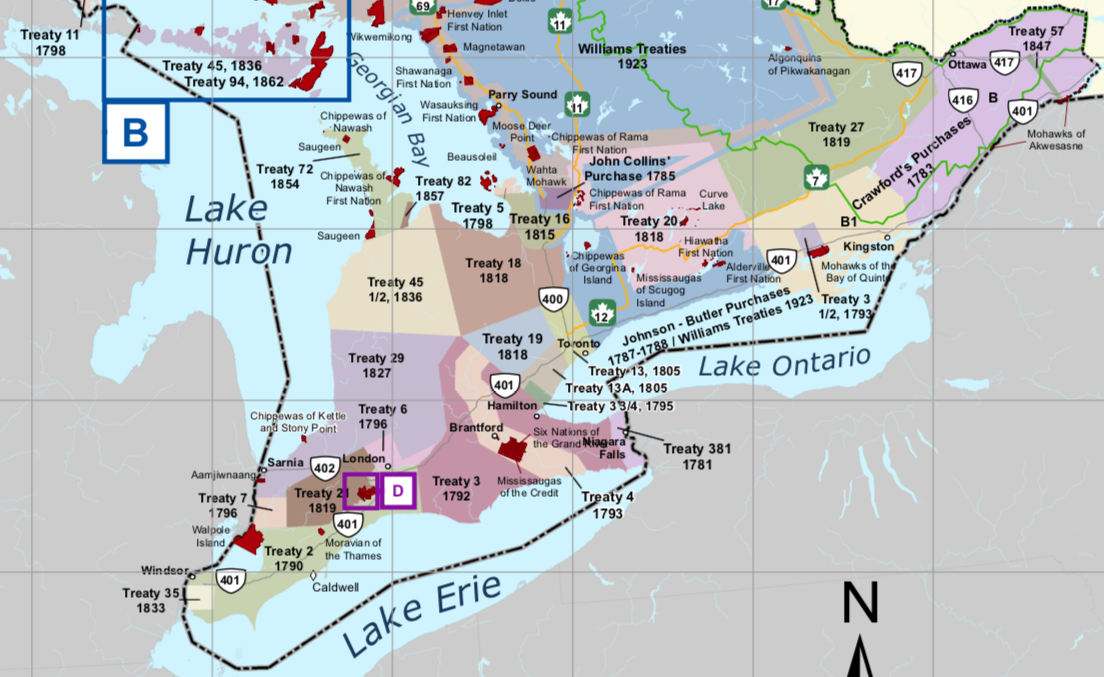
A formal agreement between the Crown and Indigenous peoples.
TREATY RIGHTS
Rights specified in a treaty. Rights to hunt and fish in traditional territory and to use and occupy reserves are examples of treaty rights. This concept can have different meanings depending on the context and perspective of the user.
TURTLE ISLAND
Turtle Island is the name many Indigenous peoples gave to the land that encompasses Canada, the United States and Mexico, before the arrival of Europeans. The name stems from the traditional creation story, in which a turtle offered to carry the land on his back. Many Nations hold their own versions of the creation of Turtle Island and you can read one belonging to the Ojibwa here: http://www.native-art-in-canada.com/turtleisland.html
RECONCILIATION
Globally, reconciliation can be considered a legal response embraced by many countries, such as post-Apartheid South Africa or the Guatemala after their Civil War, as a way to heal the wounds of racial discrimination and bring healing to the atrocities committed. In Canada, the Truth and Reconciliation Commission (TRC) was established as result of the Indian Residential Schools Settlement, a class action lawsuit (the largest in Canada) won by former Residential School students. The TRC began a multi-year process to listen to Survivors, communities and others affected by the Residential School system. Reconciliation in within the TRC framework speaks not only to educating Canadians about the history of the Residential School system but to rebuilding relationships between peoples and Canadians. Reconciliation is not only about the past; it is about the future that all Canadians will forge together.
Curriculum documents
Elementary FNMI
Indigenous culture into the classroom
Calls to action (94)
14. We call upon the federal government to enact an Aboriginal Languages Act that incorporates the following principles:
i. Aboriginal languages are a fundamental and valued element of Canadian culture and society, and there is an urgency to preserve them.
ii. Aboriginal language rights are reinforced by the Treaties.
iii. The federal government has a responsibility to provide sufficient funds for Aboriginal-language revitalization and preservation.
iv. The preservation, revitalization, and strengthening of Aboriginal languages and cultures are best managed by Aboriginal people and communities.
v. Funding for Aboriginal language initiatives must reflect the diversity of Aboriginal languages.
27. We call upon the Federation of Law Societies of Canada to ensure that lawyers receive appropriate cultural competency training, which includes the history and legacy of residential schools, the United Nations Declaration on the Rights of Indigenous Peoples, Treaties and Aboriginal rights, Indigenous law, and Aboriginal– Crown relations. This will require skills-based training in intercultural competency, conflict resolution, human rights, and anti-racism.
45. We call upon the Government of Canada, on behalf of all Canadians, to jointly develop with Aboriginal peoples a Royal Proclamation of Reconciliation to be issued by the Crown. The proclamation would build on the Royal Proclamation of 1763 and the Treaty of Niagara of 1764, and reaffirm the nation-to-nation relationship between Aboriginal peoples and the Crown. The proclamation would include, but not be limited to, the following commitments:
i. Repudiate concepts used to justify European sovereignty over Indigenous lands and peoples such as the Doctrine of Discovery and terra nullius.
ii. Adopt and implement the United Nations Declaration on the Rights of Indigenous Peoples as the framework for reconciliation.
iii. Renew or establish Treaty relationships based on principles of mutual recognition, mutual respect, and shared responsibility for maintaining those relationships into the future.
iv. Reconcile Aboriginal and Crown constitutional
and legal orders to ensure that Aboriginal peoples are full partners in Confederation, including the recognition and integration of Indigenous laws and legal traditions in negotiation and implementation processes involving Treaties, land claims, and other constructive agreements.
57. We call upon federal, provincial, territorial, and municipal governments to provide education to public servants on the history of Aboriginal peoples, including the history and legacy of residential schools, the United Nations Declaration on the Rights of Indigenous Peoples, Treaties and Aboriginal rights, Indigenous law, and Aboriginal–Crown relations. This will require skills- based training in intercultural competency, conflict resolution, human rights, and anti-racism.
86. We call upon Canadian journalism programs and media schools to require education for all students on the history of Aboriginal peoples, including the history and legacy of residential schools, the United Nations Declaration on the Rights of Indigenous Peoples, Treaties and Aboriginal rights, Indigenous law, and Aboriginal– Crown relations.
93. We call upon the federal government, in collaboration with the national Aboriginal organizations, to revise the information kit for newcomers to Canada and its citizenship test to reflect a more inclusive history of the diverse Aboriginal peoples of Canada, including information about the Treaties and the history of residential schools.
 Mme Rojo